

Introduction
SS304 and SS316L are the two most common stainless steel grades for industrial and sanitary filters. While they look similar, their corrosion resistance differs significantly. Choosing the wrong material can lead to premature filter failure, product contamination, and costly downtime.
So when must you specify SS316L over SS304? Here are four critical conditions.
1. High Chloride or Salt Environments
Chloride ions are the primary cause of pitting corrosion and stress corrosion cracking (SCC) in stainless steel.
SS304 limit: Typically ≤200 ppm chlorides. Above this, pitting begins.
SS316L limit: Contains 2–3% molybdenum, allowing it to withstand up to 1000+ ppm chlorides.
Must use 316L for: Seawater, brine, coastal outdoor installations, swimming pool water, and processes using sodium hypochlorite (bleach) for disinfection.
2. Elevated Temperatures in Corrosive Media
Corrosion accelerates with rising temperature. SS304 often fails unexpectedly in warm chloride solutions, even at moderate concentrations.
At 50–80°C (122–176°F) with any chlorides → choose 316L.
For steam or hot water with trace chlorides → 304 may pit within months, while 316L lasts years.
Typical applications: Hot water recirculation, heat exchanger pre-filters, pasteurization lines.
3. Acidic or Alkaline Process Fluids
SS304 resists mild organic acids and bases, but degrades faster in stronger or higher-temperature acidic conditions.
Acetic, citric, or dilute sulfuric acid at moderate temperature → 316L performs significantly better.
Caustic (NaOH) solutions → 316L offers a higher safety margin.
Rule of thumb: If pH <5 or >10 at >50°C, use 316L unless corrosion tables confirm otherwise.
4. Food, Pharmaceutical & Biotech Applications
These industries require not only corrosion resistance but also cleanability, surface finish, and regulatory compliance.
SS316L is the minimum standard for pharmaceutical water systems (WFI, purified water), bioreactors, and sanitary filters.
Why not 304? 316L has lower carbon content (L = Low Carbon), reducing intergranular corrosion risk after welding. It also provides smoother electropolished surfaces and better resistance to cleaning agents (CIP, SIP).
Must use 316L for: Injectable drugs, ultrapure water, dairy, beer, and CIP/SIP systems.
Conclusion:
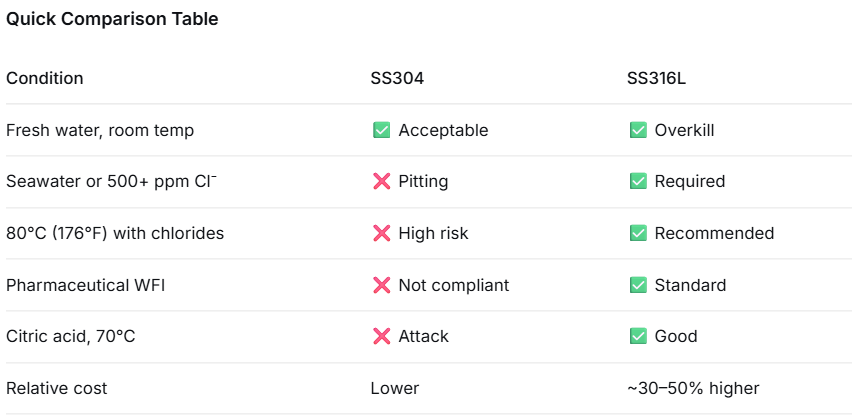
For clean, low-chloride water at ambient temperature, SS304 is economical and sufficient. However, in any of these four scenarios — high chlorides, elevated temperatures, acidic/alkaline fluids, or sanitary processing — SS316L is not a premium upgrade but a mandatory requirement.
Selecting 316L upfront avoids filter replacements, product contamination, and safety risks. When in doubt, choose 316L.